Qibla from the Quran Alone: An Orientation of Commitment, Not a Ritual Compass
A concise thesis with textual proofs from Surah Al-Baqarah and related Quranic usage.
Summary
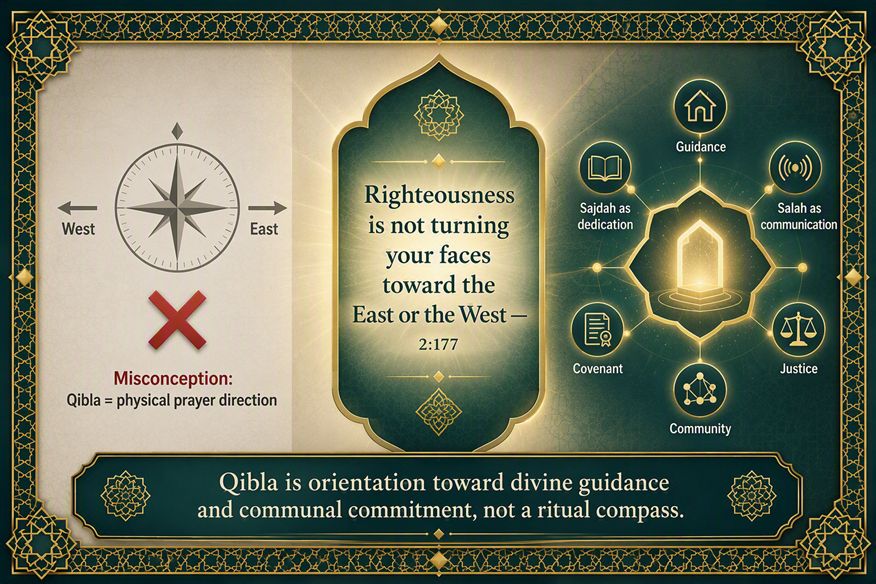
In the Quran, Qibla is best understood as an orientation of allegiance, identity, and divine direction—not as a mechanical rule that righteousness depends on facing a physical compass point. The passage beginning at 2:142 presents the controversy as a test of who follows the Messenger and who turns back, while 2:145 clarifies that differing qiblas are tied to communities, desires, and claims of authority. Most decisively, 2:177 states that righteousness is not turning one’s face toward the east or the west, but faithfulness to God, the Last Day, the angels, the Book, the prophets, giving wealth, keeping commitments, patience, and establishing a life of moral accountability.
The Problem the Quran Raises in 2:142
Surah Al-Baqarah 2:142 anticipates that “the foolish among the people” will ask why the believers have been turned away from the qibla they had been upon. The answer given is not a geometry lesson: “To God belong the east and the west. He guides whom He wills to a straight path.” The Quran immediately shifts the reader away from physical east-west fixation and toward guidance, straightness, and divine ownership of all directions.
Two Layers of the Qibla Change
Because many readers have been taught to assume that qibla simply means “the physical direction of prayer,” this section should be read carefully. The Quranic passage can be understood on two related levels. The more straightforward textual reading is that the qibla concerns a test of orientation during the unfolding of revelation. As Allah’s guidance came through the Messenger, those who were sincere continued in the same true direction: following Allah. To outsiders, or to those attached to inherited forms, this could look like instability or contradiction: “Why have they turned away from what they were upon?” But inwardly, the believer had not changed direction at all. The believer’s qibla was never a compass point; it was obedience to Allah’s guidance.
The second level is a broader application of the same principle. Before guidance reaches a person, he is often already upon an inherited qibla: the religion of forefathers, the identity of a community, or the authority of a tradition. When he accepts Allah’s guidance, the foolish may ask why he has turned away from what he was upon, as though ancestry itself determines truth. This reading should not be treated as the primary proof by itself, but it follows naturally from the same Quranic logic: when truth comes, inherited direction must yield to revealed guidance.
Therefore, there is room for both perspectives. First, the text presents a direct test of whether people follow guidance as it comes through the Messenger. Second, the same test appears in the life of anyone who leaves an inherited religious orientation for Allah’s guidance. The apparent change is external; the real continuity is obedience. Thus the test mentioned in 2:143 is not a test of loyalty to a compass point, but a test of whether one’s true qibla is inherited identity, communal pressure, and visible form—or Allah’s guidance as delivered through His Messenger.
A Convert’s Reflection
For a convert, this verse can carry special resonance. Before accepting Islam, a person may have been upon another qibla—not merely another physical direction, but another inherited religious orientation. After accepting the Quran’s guidance, people may ask why he left the religion of his forefathers. But the question itself exposes the problem: what does the practice of forefathers have to do with truth? In that sense, the Quran’s description of such questioners as “the foolish among the people” tracks with the convert experience without making personal experience the foundation of the argument.
The issue is not simply that believers moved from one valid ritual direction to another valid ritual direction. Rather, Allah turns people away from inherited orientations and tests whether they will follow revealed guidance or retreat into the familiar loyalties of their former communities. This preserves the Quranic sequence: the text leads, the lived experience illustrates, and Allah’s guidance remains the measure of truth.
The Clarification in 2:145
Verse 2:145 clarifies the matter by saying that even if every sign were brought to the People of the Book, they would not follow “your qibla”; nor would the Messenger follow “their qibla”; nor would some of them follow the qibla of others. Verse 2:146 then intensifies the point: those given the Book recognize this as they recognize their own sons, yet a party of them conceals the truth knowingly. The only way they can know this to be truth from their Lord is if they too understand the practice of establishing a sanctified communal center—a church, synagogue, temple, or equivalent place around which a community orients itself. This language is difficult to reduce to a private prayer direction. The verse speaks of competing orientations, loyalties, and communal commitments. It places qibla in the realm of what communities follow and recognize, not merely where bodies point.
2:177: The Decisive Guardrail
Surah Al-Baqarah 2:177 directly prevents the flattening of religion into directional formalism: righteousness is not that you turn your faces toward the east or the west. The verse then defines righteousness through belief, generosity, covenant-keeping, steadfastness, and moral conduct. If righteousness is explicitly not face-turning toward east or west, then any interpretation of qibla that makes religious validity depend on directional face-turning must be subordinated to this Quranic correction.
How the Word Is Used
The word qibla appears in the Quran in a small cluster: 2:142, 2:143, 2:144, 2:145, and 10:87. In Al-Baqarah, the word is bound to turning, following, being tested, and distinguishing who follows the Messenger from who turns back. The contrast with 10:87 is especially important: Muhammad is being given al-Masjid al-Haram—a dedicated place for sajdah and a central place for the community to align with—while Moses and his brother are inspired to make their houses the qibla and establish salah, understood here as communication. Under Pharaoh, a public sanctified center would likely have been destroyed, so Allah guided them to have their homes as centers of orientation and communication for the believers.
Key Quranic Texts
Al-Baqarah 2:142
سَيَقُولُ ٱلسُّفَهَآءُ مِنَ ٱلنَّاسِ مَا وَلَّىٰهُمْ عَن قِبْلَتِهِمُ ٱلَّتِى كَانُوا۟ عَلَيْهَا ۚ قُل لِّلَّهِ ٱلْمَشْرِقُ وَٱلْمَغْرِبُ ۚ يَهْدِى مَن يَشَآءُ إِلَىٰ صِرَٰطٍۢ مُّسْتَقِيمٍ
Taqi Usmani: The foolish among the people will say: “What has turned them away from their Qiblah which they used to observe?” Say: “To Allah belong the East and the West. He guides whom He wills to a straight path.”
Al-Baqarah 2:145–146
وَلَئِنْ أَتَيْتَ ٱلَّذِينَ أُوتُوا۟ ٱلْكِتَـٰبَ بِكُلِّ ءَايَةٍۢ مَّا تَبِعُوا۟ قِبْلَتَكَ ۚ وَمَآ أَنتَ بِتَابِعٍۢ قِبْلَتَهُمْ ۚ وَمَا بَعْضُهُم بِتَابِعٍۢ قِبْلَةَ بَعْضٍۢ ۚ وَلَئِنِ ٱتَّبَعْتَ أَهْوَآءَهُم مِّنۢ بَعْدِ مَا جَآءَكَ مِنَ ٱلْعِلْمِ ۙ إِنَّكَ إِذًۭا لَّمِنَ ٱلظَّـٰلِمِينَ
ٱلَّذِينَ ءَاتَيْنَـٰهُمُ ٱلْكِتَـٰبَ يَعْرِفُونَهُۥ كَمَا يَعْرِفُونَ أَبْنَآءَهُمْ ۖ وَإِنَّ فَرِيقًۭا مِّنْهُمْ لَيَكْتُمُونَ ٱلْحَقَّ وَهُمْ يَعْلَمُونَ
Taqi Usmani: Even if you bring every sign to those who have been given the Book, they shall not follow your Qiblah, and you are not to follow their Qiblah, nor are they to follow one another’s Qiblah. If you were to follow their desires after the knowledge that has come to you, then you would be among the unjust. Those whom We have given the Book recognize him as they recognize their sons, and surely a group of them conceal the truth while they know.
Al-Baqarah 2:177
لَّيْسَ ٱلْبِرَّ أَن تُوَلُّوا۟ وُجُوهَكُمْ قِبَلَ ٱلْمَشْرِقِ وَٱلْمَغْرِبِ وَلَـٰكِنَّ ٱلْبِرَّ مَنْ ءَامَنَ بِٱللَّهِ وَٱلْيَوْمِ ٱلْـَٔاخِرِ وَٱلْمَلَـٰٓئِكَةِ وَٱلْكِتَـٰبِ وَٱلنَّبِيِّـۧنَ وَءَاتَى ٱلْمَالَ عَلَىٰ حُبِّهِۦ ذَوِى ٱلْقُرْبَىٰ وَٱلْيَتَـٰمَىٰ وَٱلْمَسَـٰكِينَ وَٱبْنَ ٱلسَّبِيلِ وَٱلسَّآئِلِينَ وَفِى ٱلرِّقَابِ وَأَقَامَ ٱلصَّلَوٰةَ وَءَاتَى ٱلزَّكَوٰةَ وَٱلْمُوفُونَ بِعَهْدِهِمْ إِذَا عَـٰهَدُوا۟ ۖ وَٱلصَّـٰبِرِينَ فِى ٱلْبَأْسَآءِ وَٱلضَّرَّآءِ وَحِينَ ٱلْبَأْسِ ۗ أُو۟لَـٰٓئِكَ ٱلَّذِينَ صَدَقُوا۟ ۖ وَأُو۟لَـٰٓئِكَ هُمُ ٱلْمُتَّقُونَ
Taqi Usmani: Righteousness is not that you turn your faces toward the East and the West; but righteousness is that one believes in Allah, the Last Day, the angels, the Book and the prophets, and gives wealth, despite his love for it, to relatives, orphans, the needy, the wayfarer, those who ask, and for freeing slaves; and establishes Salāh and pays Zakāh; and those who fulfill their covenant when they make one, and those who are patient in hardship and suffering and at the time of battle. Those are the ones who are truthful, and those are the God-fearing.
Yunus 10:87
وَأَوْحَيْنَآ إِلَىٰ مُوسَىٰ وَأَخِيهِ أَن تَبَوَّءَا لِقَوْمِكُمَا بِمِصْرَ بُيُوتًۭا وَٱجْعَلُوا۟ بُيُوتَكُمْ قِبْلَةًۭ وَأَقِيمُوا۟ ٱلصَّلَوٰةَ ۗ وَبَشِّرِ ٱلْمُؤْمِنِينَ
Taqi Usmani: And We revealed to Mūsā and his brother: “Have houses for your people in Egypt, and make your houses worship oriented, and establish Salāh, and give good tidings to the believers.”
A Quran-Alone Reading
A Quran-alone reading should let the Quran define its own terms through immediate context, repeated usage, and explicit corrections. In this case, the immediate context points to a change in orientation that exposes obedience, allegiance, and resistance. The repeated language of “following” in 2:145 shows that qibla is tied to a path people accept or refuse. The explicit correction in 2:177 prevents the concept from being reduced to east-west face-turning. Read together, these verses show that qibla is concrete but not shallow: it concerns the center around which a community is oriented, the authority it follows, and the guidance it accepts when Allah makes truth clear.
Potential Questions and Answers
Does this make qibla merely metaphorical?
No. The argument is not that qibla is unreal or merely symbolic. Rather, qibla is concrete but more than directional. It is a real communal orientation: the center around which authority, identity, sajdah, salah, covenant, justice, and allegiance are organized.
Were believers previously wrong?
Not necessarily in a simplistic way. Before guidance reaches a person, he may be upon an inherited system. Once guidance comes, the question becomes whether he responds to it. The Quranic test is not whether one can defend what he inherited, but whether he will follow what Allah reveals when it becomes clear.
But does 2:143 imply that Allah appointed a former qibla?
Yes, and this can be understood without reducing qibla to a permanent compass rule. Allah may appoint or allow a prior orientation within the unfolding process of guidance in order to test people. Its purpose is diagnostic: to distinguish who follows the Messenger from who turns back. A test can be real without being the final definition of righteousness.
Does 2:177 cancel the whole qibla discussion?
No. It does not erase the qibla discussion; it governs how the discussion must be understood. Since righteousness is explicitly not turning faces toward east or west, qibla cannot be made the essence of righteousness as physical face-turning. The qibla matter must be read under the higher Quranic definition of righteousness: faith, covenant, generosity, patience, justice, and obedience to Allah.
Why would the People of the Book recognize this?
Because they already understood the relationship between revelation, sanctified communal centers, and religious orientation. Their own traditions had temples, synagogues, churches, scriptures, priesthoods, and inherited communal identities. Thus the Quran’s discussion of qibla would not be alien to them. What they resisted was not the intelligibility of the concept, but the truth of Allah’s guidance coming through the Messenger.
Conclusion
The Quran’s treatment of qibla is deeper than a ritual compass. It is about what direction a community is turned by Allah, what authority it follows, and whether it recognizes guidance when it comes. The believer’s true continuity is not attachment to a physical direction, inherited identity, or religious formalism, but continued obedience to Allah as He reveals guidance. Reducing qibla to a monitored bodily habit risks missing the Quran’s own emphasis: Allah owns the east and the west, guidance is the true direction, and righteousness is proven by faith, justice, loyalty, generosity, covenant-keeping, and patient perseverance—not by the mere turning of faces.